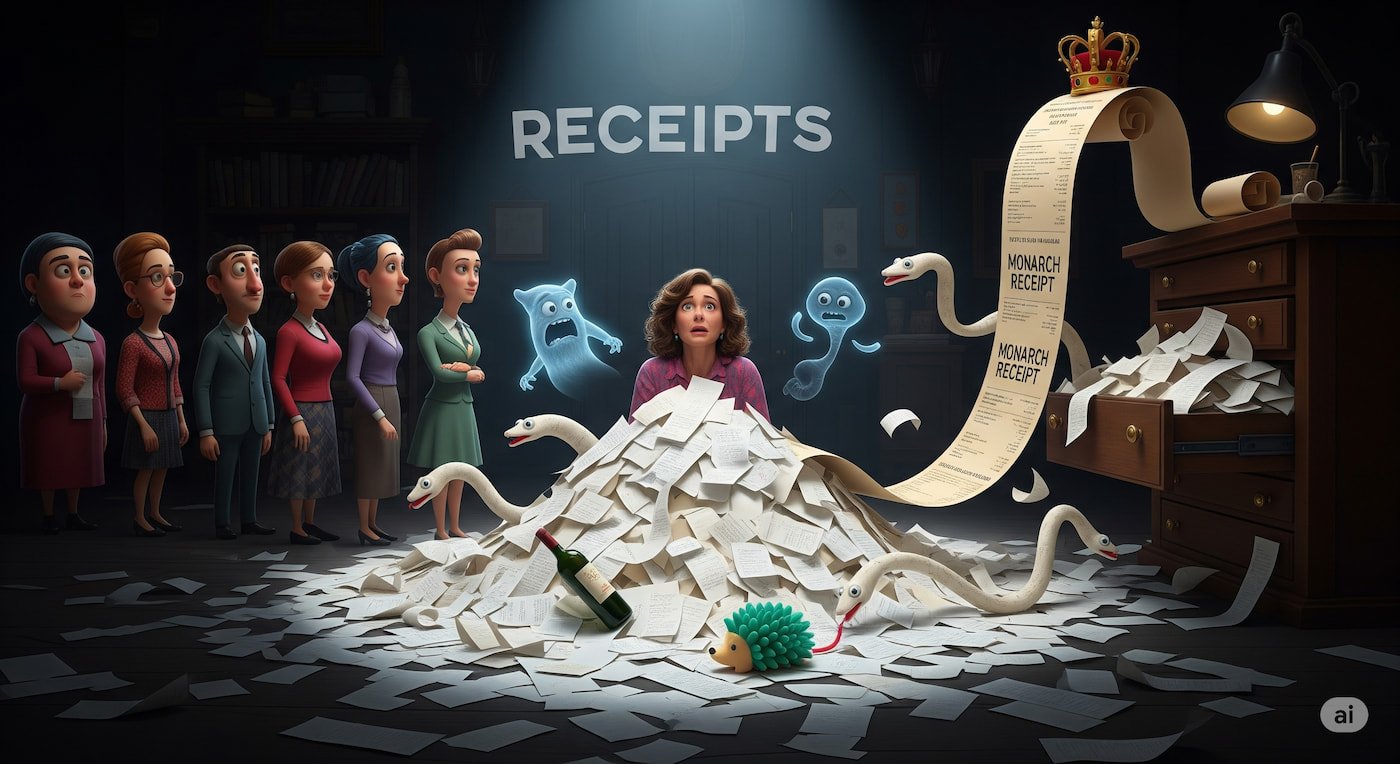
The Receipts Monologue
The receipt, darling, whips through the till, a thin paper train rattling into my hands. Receipts are the trees’ revenge: once standing tall in sunlit forests, now severed by the labour of silent hands and reborn to fuel our consumer habits. Each time a receipt prints, it’s another piece of tree, sacrificed for a brief moment of accountability. You pop in for milk, leave with a novella. Chapter One: semi-skimmed. Chapter Two: crisps you didn’t need. By Chapter Three, you’re questioning the hedgehog-shaped sponge. The receipt knows. The receipt always knows.
They act like pompous monarchs. Every yoghurt, every loo roll, every biscuit: declared with fanfare. And when the announcements seem endless, the cashier asks, ‘Would you like your receipt?’—as though you haven’t just been handed the Dead Sea Scrolls, yoghurt stains included.
Receipts serve many roles, never settling for just one. They turn up as a cast, each with a story to tell.
- The Eternal Scroll: So long it doubles as a scarf. Always printed when you’ve bought nothing more than a tin of beans.
- The Fader: Bold at birth, ghostly by nightfall. Leave it in the sun, and it becomes a blank prophecy.
- The Hoarder: Buried in handbags, mingling with bus tickets, multiplying in drawers until they form colonies.
- The Accuser: The one you find when you’re weak, its ink still clear: three packets of biscuits, 10.42 p.m.
- The Historian: The tax receipt. Crucial, cryptic, and always disappearing until the last possible second.
Once, attempting to return a jumper, I brandished The Fader—my receipt, or rather a slip sparkling with transparency. The assistant frowned: ‘Sorry, love, can’t take it without proof of purchase.’ Proof? Was I to produce witnesses? Call the hedgehog sponge to the stand?
Receipts infest drawers, glove compartments, and even pockets. They also hide behind sofa cushions, waiting to be rediscovered. Years later, these slips tumble out, recording your snack history better than any diary. Just as cathedrals keep relics of saints, we keep slips that prove we once bought reduced coleslaw.
Despite their ubiquity, receipts are honest. Brutally so. They don’t flatter. They don’t excuse. They never let you pretend you only bought ‘essentials.’ They catalogue the biscuits, the wine, the sausage rolls. They broadcast your secrets in thermal ink.
So let us applaud them—useless, overlong, prone to vanishing—yet loyal scribes of our petty lives. Each one is a reminder that convenience has a cost. When the shopping is bagged and the slips folded, we step back into the world: triumphant, weary, faintly ashamed. The trees, darling, never forgave us. Now, they just keep score.
You are reading about
Receipts
darling!
Below is the unedited version of my post. Think of it as the backstage view: scruffy, overlong, sometimes brilliant by accident, sometimes a shambles. It hasn’t been tidied, polished, or persuaded into shape; it’s simply what spilt out first. I keep it here because you might enjoy seeing where the monologue began, before the edits stitched up its hems and powdered its nose.
The Receipt Before It Was Ready
Receipts, darling, are the trees’ revenge. Once proud oaks, now reborn as paper snakes that coil in your handbag until they hiss their presence months later. You go in for milk, come out with a novella. Chapter One: semi-skimmed. Chapter Two: Impulse Crisps. The receipt never forgets, even when you do. It will still be there in five years, reminding you that you once bought chewing gum on a Wednesday, like some sordid confession.
Receipts behave like monarchs: long, pompous, and convinced of their own importance. They announce every yoghurt and multipack as if proclaiming a royal decree. You stand there, waiting politely, while the till churns out an epic longer than the Iliad just to confirm you spent £3.42 on loo roll. And then — insult of insults — the cashier asks, ‘Would you like your receipt?’ As though you’ve not already been handed your papyrus scroll like a prophet returning from Sinai.
Of course, receipts are not content with being paper. They dabble in invisibility. Left in the sun, they fade into pale ghosts — proof of nothing, a whisper of ink where once there was glory. Try returning something then. You hand over what looks like a blank page from a child’s sketchbook, and the assistant squints, as if you’ve forged the Magna Carta with invisible ink. ‘Sorry, love, can’t accept it without proof of purchase.’ Proof? The carrier bag isn’t enough? My wounded dignity?
Some receipts develop a second life. They curl at the bottom of handbags, fraternise with old bus tickets, and stage clandestine meetings with shopping lists. Others migrate to drawers, waiting for tax season like condemned men awaiting trial. You swear you’ll sort them. You never do. They multiply in the dark, building colonies, forming alliances, until one day you open the drawer and the entire history of your snack consumption floods out like a bureaucratic avalanche.
Yet receipts are honest in a way no politician ever manages. They tell the unvarnished truth. You didn’t ‘pop in for essentials’ — you bought biscuits, wine, and a novelty sponge shaped like a hedgehog. They shame you, these strips of truth, waving your little secrets like flags. And still you fold them, tuck them away, cradle them as if one day you’ll need to prove you really did buy cough syrup on March 14th.
So let us honour the receipt, darling. Useless, overlong, prone to vanishing — but a loyal archivist of our petty lives. Cathedrals keep relics of saints; we keep the slip that records two-for-one pizzas. And when the tills fall silent, when the paper trail ends, who will remember us better than the receipts?