The Queues Monologue
Queues, darling, are Britain’s only actual national sport. Forget cricket, forget football: those are practice runs. The real contest happens outside the post office at half past eleven, where twenty strangers stand in a silent battle of endurance. This is not a line. This is theatre, opera, pantomime: patience in full costume.
The queue is alive. A grey python sliding down the pavement, swallowing handbags, wallets, and frozen peas as it goes. It feeds on time. It feeds on hope. You edge forward, sure the end is near — but no. That was the queue teasing you, dangling optimism like a carrot, before the till jams and the cashier begins a five-act tragedy with the card reader as Hamlet and your debit card as the doomed Ophelia.
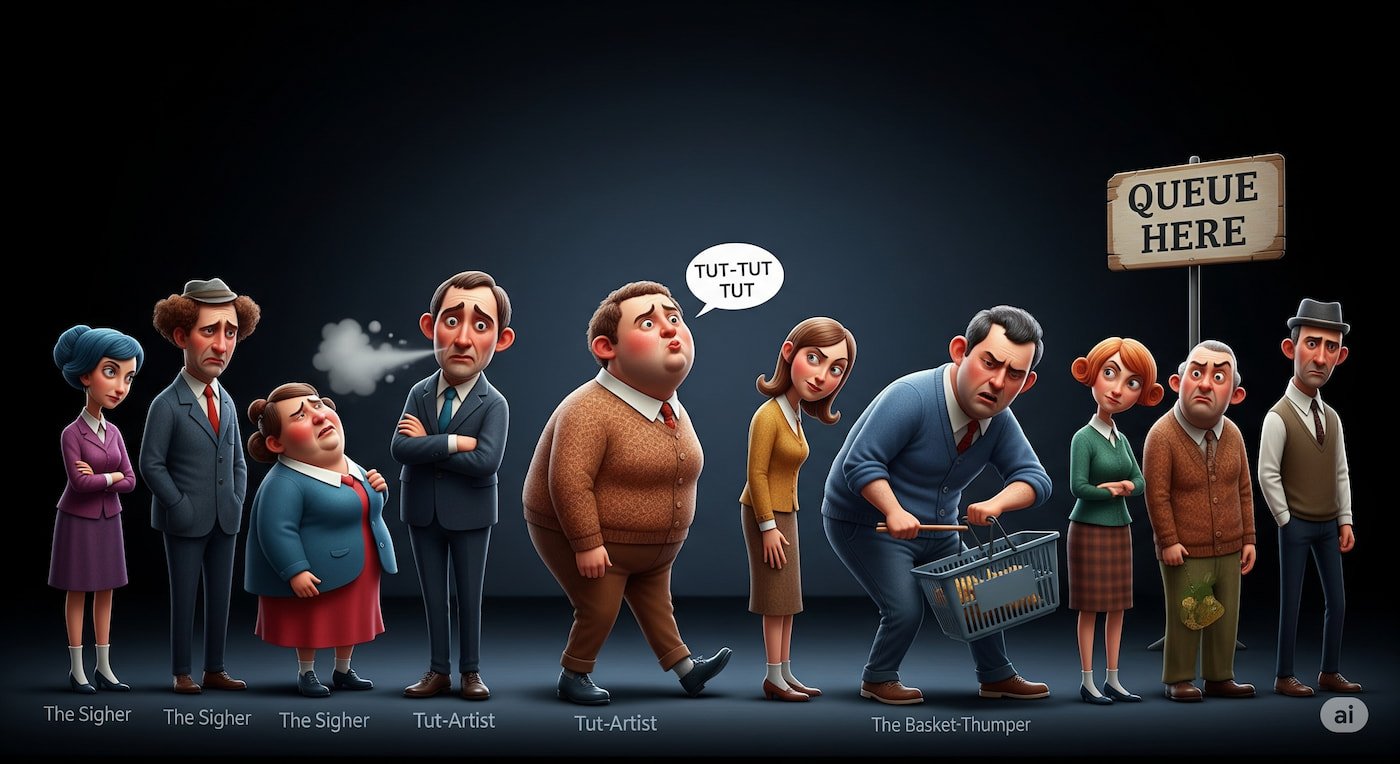
The cast is reliable. The Sigher, a foghorn of despair. The Tut-Artist, percussionist of irritation. The Basket-Thumper, banging plastic like a warning drum. The Neck-Craner, convinced that stretching one’s neck bends time itself. And the Rule-Reciter, whose immortal wisdom is: ‘It always moves faster if people have their money ready.’ Each plays their role with grim dedication. And me? I’m the Narrator, conducting this chorus of suppressed fury with the flick of a receipt.
The queue is not merciful. Step out — even briefly, for a sandwich or a glance at the scratchcards — and you return to find your place gone, your dignity gnawed away. Once, I saw a man try to cut in. The silence that followed could have cracked stained glass. He slunk back, chastened, like a fox caught stealing sausages.
But queues demand spectacle. Outside Greggs, they become morality plays. Will the last sausage roll survive? Who dares order six steak bakes in front of the starving? Outside Argos, queues turn ghostly: catalogue numbers whispered like spells, suspense mounting until a box appears from the mysterious stockroom. At the chemist, queues slip into Greek tragedy: every face knows why it’s there, but no one speaks the word aloud.
And then there are queues beyond shops. The train platform queue, where neat rows collapse into chaos at a single door. The theatre loo queue, a ballet of crossed legs and false smiles. And, my favourite invention, the queue for the afterlife: souls clutching numbered tickets, muttering that St Peter really ought to open another window.
And yet — we adore it. We return willingly, as if craving another curtain call. Because the queue, harsh though it is, is fair. It does not flatter. It does not forgive. But it treats everyone the same. From duchess to dustman, student to pensioner, all shuffle forward in equal measure towards the altar of the beeping till. Hierarchy dissolves. Misery equalises.
So let us raise our baskets and salute the queue: parliament of patience, cathedral of complaint, coliseum of muttered disapproval. The queue is our ritual, our anthem, our national sport. And when at last it dissolves, when the bags are packed and the receipts tucked away, we step back into the world triumphant — weary, relieved, and secretly ready for the next performance. Because really, darling, what else would we do with a Saturday morning?
You are reading about
Queues
darling!
Below is the unedited version of my post. Think of it as the backstage view: scruffy, overlong, sometimes brilliant by accident, sometimes a shambles. It hasn’t been tidied, polished, or persuaded into shape; it’s simply what spilt out first. I keep it here because you might enjoy seeing where the monologue began, before the edits stitched up its hems and powdered its nose.
The Queue Before It Was Ready
Queues, darling, are Britain’s only actual national sport. Forget cricket, forget football — those are just warm-ups. The real tournament begins outside the post office at half past eleven, where twenty strangers form a line to see who can endure the longest without collapsing into open rebellion. It is theatre, opera, pantomime and silent protest all at once. It is boredom in full costume.
The queue is not an object. It is alive. A great grey python slithers down the pavement, swallowing handbags, wallets, and frozen peas as it goes. It does not feast on food but on time and optimism. You may think you’ve reached the front, but no — that was merely the queue teasing you, dangling hope like a carrot, before the till jams and the cashier begins a five-act tragedy with the card reader as the leading man.
The cast is impeccable. There is the Sigher, exhaling gusts of theatrical despair. The Tut-Artist, a percussionist of irritation. The Basket-Thumper, who makes their displeasure known through interpretive percussion against plastic. And me? I am the Narrator, obviously, conducting this chorus of suppressed rage with the flick of a crumpled receipt. Each character knows their role. Each delivers their lines at precisely the proper interval, like a symphony of British discontent played sotto voce.
Do not be fooled into thinking the queue is patient. It is vindictive. Step out of line — just briefly, for a sandwich or a glance at the magazines — and you will return to find your place erased, your dignity nibbled away. Once, I saw a man attempt to cut in. The silence that followed could have stripped varnish from a church pew. He slunk back to his place, chastened, like a fox caught stealing sausages from the vicarage garden.
And yet — we adore it. We embrace the queue as willingly as a ritual. We stand there like actors begging for another curtain call. Because the queue, harsh though it may be, is fair. It does not flatter. It does not forgive. But it treats us all the same. From duchess to dustman, from pram-pusher to pensioner, we shuffle step by step towards the altar of the beeping till. The hierarchy dissolves into orderly misery. There is democracy here, if nowhere else.
Do not underestimate the spectacle. A queue outside Greggs on a Saturday morning is a morality play. Will the last sausage roll survive? Who dares to order six steak bakes when others are famished behind them? The judgement is silent, but it is devastating. A queue outside Argos is a ghost story — long corridors, mysterious catalogue numbers, and a suspense that builds until, at last, the box arrives. And the queue outside the chemist? That is Greek tragedy itself. We all know why we’re there, but no one dares to say it aloud.
The thing about queues — well, everything, really — is that they are mirrors. They show us ourselves, stripped of glamour. How do we behave when trapped in a human snake, creeping forward at the pace of a dying tortoise? Do we fume, sigh, or gossip? Do we make eye contact with our fellow sufferers, or do we pretend the queue is a private island, that these people are not our kin in patience?
Queues are our heritage. They are our parliament of patience, our cathedral of complaint, our coliseum of muttered disapproval. They bind us together in silent fellowship. They whisper: you belong here, in this absurd national ritual. And when at last the till beeps, the bags are packed, and the line dissolves, we step back into the world — triumphant, relieved, and secretly ready for the next performance. Because honestly, darling, what else would we do with a Saturday morning?